
Understand your first result
Tell the requested goal, preview and measured attempt apart.
The goal
A goal describes what you wanted. The chosen task defines what motions and success criteria are supported. A picture of the target is an intention, not measured robot state.
The preview
Preparation checks a candidate and may estimate feasibility. It helps you decide whether to try. It is not evidence that an attempt succeeded.
The attempt
An attempt uses a frozen revision. Read its outcome, method, target and limits. Keep failures and cancellations: they explain what happened, even when a later attempt succeeds.
Recorded playback
Playback shows retained samples from that attempt. It is read-only. Missing samples or unavailable downloads are gaps, not permission to invent a smooth trajectory. Replay does not start another attempt.
Learn from one difference
Write what you expected, what you observed and what you would change. One success does not prove reliability across every target, another installation or a physical robot. A programmed controller's success also does not mean the robot learned a new policy.
A target and a measured attempt
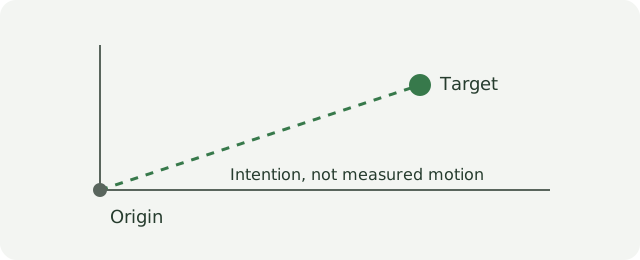
The target X = 0.20 m describes an intended coordinate in the declared robot frame. It is not a guarantee of reachability. Read the supported bounds in your workspace before choosing a value.
| What you see | What it means |
|---|---|
| Target marker | Requested tool point. Intention |
| Preparation preview | Candidate feasibility. No completed attempt |
| Retained samples | Recorded evidence from the original attempt |
On iPhone
Use Edit goal to return to the selected workspace. Precise coordinates offers accessible metric values. Place in AR is optional.
On Mac
The result above the scene describes the whole attempt. The blue marker is the robot’s tool tip. The green marker is its target. A new recording opens paused at its first state.
Choose Play to watch the retained states. Slow (0.25×) takes four times as long as the original simulation. Choose Very slow (0.1×) to inspect motion at one tenth speed. Use Previous recorded state, Next recorded state or the slider to inspect one pose at a time. The displayed time is simulation time. The distance describes the selected state, even when the attempt’s final result says Succeeded. Poses change only at recorded times. Motion between retained states is not shown or invented. Replay returns to the beginning without starting another simulation. Reopening a result restores your selected state.
Open Result details for the success rule, final measurements and limits. Missing scenes or samples remain explicit gaps. Return to my draft restores your separate current goal. Edit this attempt’s goal opens the recorded revision for correction while preserving the original result. You do not need to pair a phone just to interpret the Mac result. Choose Explain this result to ask about the selected attempt beside the scene. Review the named context before allowing replies. Open discussed result returns to the exact attempt without closing assistance.
For general frames and transformations, see Modern Robotics: rigid-body motions.
Lesson 2: intention and evidence
Example
Use the same table-mounted arm and target: (20, 0, 15) cm from the base. Success means the tip ends within 1 cm of the target. These are fictional teaching cards, not actual run evidence.
Card A · Request: “Move the tip to (20, 0, 15) cm.”
Card B · Preview: “The target appears reachable.” A preview is a prediction before movement.
Card C · Measured result: “After the attempt, the tip ended 2 cm from the target.” A measurement records what happened.
Your turn
Choose your answers before checking:
Which card tells you what actually happened: A, B or C?
Did the attempt meet the 1 cm success rule?
Suppose you have only A and B because no attempt was made. Which conclusion is justified: “It succeeded” or “It may be reachable, but it has not been tried”?
Suppose an attempt finished, but its final measurement is missing. Can you decide whether it met our success rule?
Check your reasoning
C. A describes the intention, B predicts feasibility, C supplies a measured outcome. A prediction can be wrong.
No. The measured 2 cm error exceeds our 1 cm tolerance, even though the preview looked promising. A finished attempt can still miss its target.
“It may be reachable, but it has not been tried.” A preview cannot establish successful movement.
No, the result is unknown from the supplied information. “Finished” tells us the attempt ended. Without its final measurement, we cannot check the distance. Missing evidence does not prove success or failure.
You can now separate what was requested, what was predicted and what was measured. Next, use measured results to plan a fair comparison.
From this written example to a live task
The fictional 1 cm final-position rule above is a teaching example. A live task has its own displayed success criterion. Roboty’s supported Reach criterion requires the tool point within 12 mm for 250 continuous simulated milliseconds. Read the rule shown with the selected task before comparing an actual result.
Page tools
Read as Markdown for copying or use with an AI agent.